
A buyer manages four hundred suppliers and roughly the same amount of attention to give each one. So the loud ones get it — the supplier who calls, the invoice that bounced, the fire of the week — while a quiet single-source component that could halt the line sits unmanaged until the day it doesn’t arrive. Effort flows to noise, not to risk or value. That is the default state of most purchasing portfolios, and it is expensive in both directions: you over-service items that don’t matter and under-protect the ones that do.
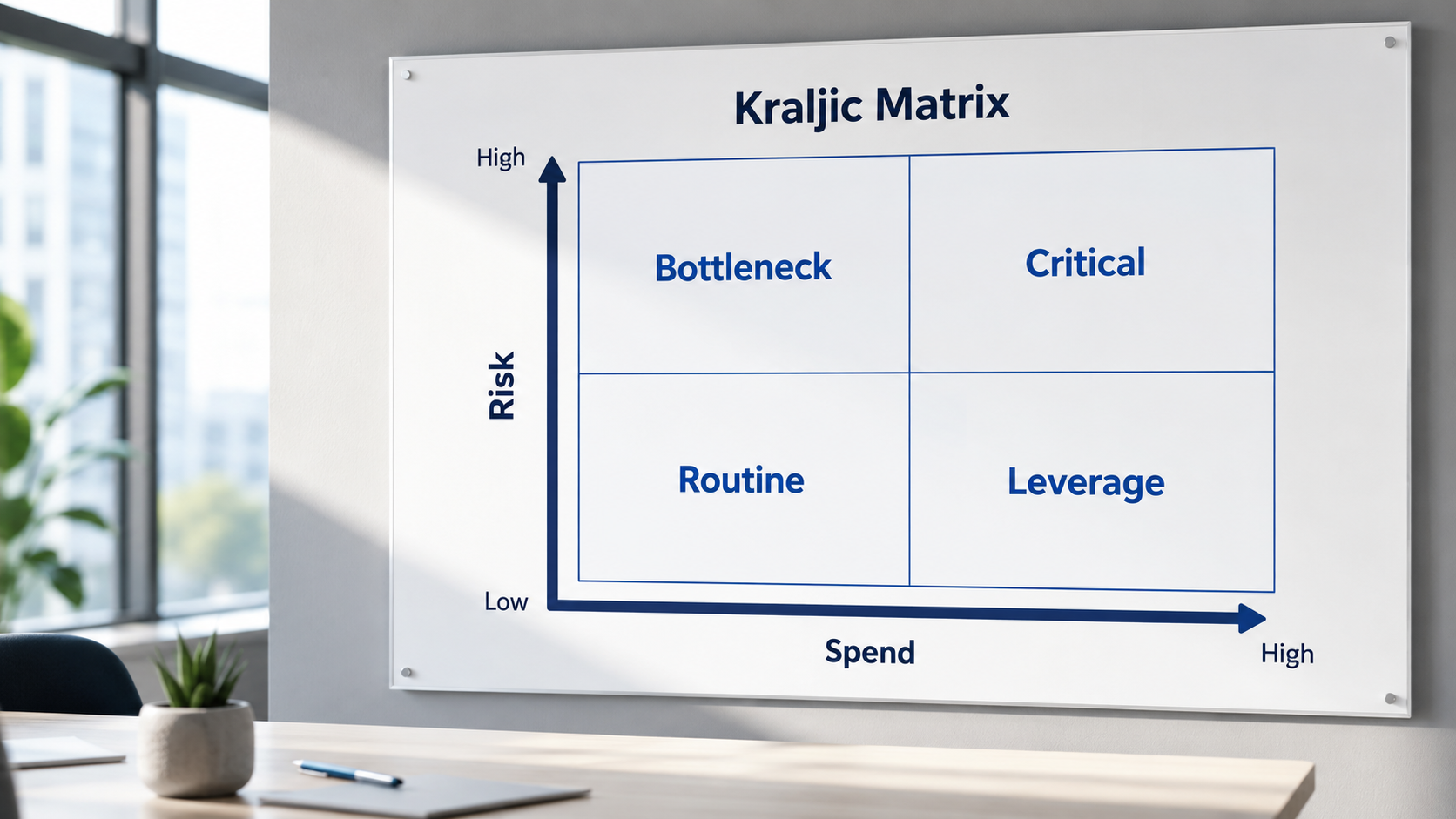
The Kraljic Matrix is the antidote. Introduced by Peter Kraljic in 1983 and now the most widely used portfolio tool in procurement, it does one deceptively simple thing: it sorts everything you buy into four groups on two axes, so that each group gets the strategy it actually needs. Not one procurement approach applied to everything, but four — deliberately different. This guide explains the two axes, walks through the four quadrants and the play for each, adds the move most buyers miss (seeing yourself through the supplier’s eyes), and shows how to build the matrix without boiling the ocean.
The two axes
Everything in the matrix hangs on two questions, asked of each category of spend:
- Profit impact (the horizontal axis) — how much does this category matter to the business? Think spend value, share of total cost, impact on product quality or on the customer, growth. High profit impact means there is a real prize in buying it well.
- Supply risk (the vertical axis) — how hard and how dangerous is it to source? Think number of capable suppliers, availability, switching difficulty, and the damage done if delivery fails. High supply risk means the market has power over you.
Score each category high or low on the two axes and it lands in one of four quadrants. The insight is that these two questions are independent: a cheap item can be high-risk, an expensive item can be low-risk, and the right strategy depends on which combination you’re facing.
(A note on labels: Baily and other UK texts plot the same picture with the axes named “risk” and “procurement potential,” and call the quadrants critical, bottleneck, leverage and routine. The names differ; the logic is identical.)
The four quadrants
| Quadrant | Supply risk | Profit impact | Typical items |
|---|---|---|---|
| Strategic (critical) | High | High | Custom assemblies, key raw materials, single-source technology — vital and expensive |
| Bottleneck | High | Low | Low-value but hard-to-source: proprietary spares, a monopoly consumable, a specialist certification |
| Leverage | Low | High | High spend, many suppliers: standard materials, freight, commodities, packaging |
| Non-critical (routine) | Low | Low | Low-value, plentiful: office supplies, MRO consumables, catalogue items |
Two of these are counter-intuitive, and they are the ones that catch buyers out. Bottleneck items are small in spend but can stop the operation — a €200 part with one qualified supplier deserves more attention than its invoice suggests. Leverage items are the opposite: large spend, low risk, and therefore your single biggest opportunity to move the number.
The play for each quadrant
The whole point of segmenting is to act differently. Here is the strategic aim for each box.
Leverage — use your power
Low risk, high spend, many capable suppliers: you hold the stronger hand, so the aim is to maximise commercial advantage. Run competitive tendering and e-auctions, consolidate volume to sharpen your leverage, standardise specifications so more suppliers can bid, and negotiate hard on price. This is where aggressive sourcing pays, and where most of a buyer’s measurable savings are made. (See our companion piece, 7 Cost Reduction Levers Every Buyer Should Know.)
Strategic — partner, don’t squeeze
High risk and high value: these are the categories that make or break the business, and you cannot simply beat the supplier down without endangering supply. The aim is security plus value through partnership. Build close, long-term relationships with trusted suppliers, collaborate on cost and innovation, involve them early, share forecasts, and manage the relationship actively rather than transaction by transaction. Total cost of ownership — not unit price — is the right lens here. (See Total Cost of Ownership: Why the Cheapest Offer Rarely Is.)
Bottleneck — guarantee continuity
High risk, low value: the danger is not price, it’s the line stopping. The aim is assurance of supply. Reduce the risk by knowing the market in detail, forecasting requirements accurately, holding buffer or consignment stock, qualifying alternative sources, and locking continuity into the contract. Where you can, engineer the problem away — redesign to a standard part, or bundle the item with attractive business to make yourself a customer the supplier wants to keep.
Non-critical — spend less managing it
Low risk, low value: the biggest cost here is the cost of buying it. The aim is efficiency. Automate ordering, use catalogues and e-procurement, consolidate to fewer suppliers, delegate to end users within guardrails, and free your own time for the quadrants that reward it. Every hour spent negotiating paperclips is an hour stolen from leverage and strategic. (Uncontrolled buying here is also where maverick spend breeds — see Maverick Spend: Why It Happens and How to Bring It Under Control.)
The move most buyers miss: how the supplier sees you
Segmenting your spend tells you how you view the supplier. It says nothing about how the supplier views you — and a strategy that ignores that half is naïve. A key supplier who considers your account small or troublesome will not partner with you no matter how “strategic” the category is on your grid.
This is supplier preferencing: plotting each supplier on how attractive your account is to them (share of their profit, prestige, ease of dealing) against the value of their business. Cross it with your Kraljic view and the strategy sharpens. If a category is strategic to you but you’re a marginal customer to the supplier, partnership is a fantasy until you change their perception — by consolidating volume with them, bundling attractive business, or improving how you are to deal with. Check the supplier’s likely view of you before you build a relationship strategy on the assumption they’ll say yes.
How to build your matrix without boiling the ocean
You do not need perfect data to start. A defensible first pass takes five steps:
- Start from spend analysis. Pull twelve months of spend by category. You cannot segment what you can’t see — clean, categorised spend is the foundation. (See Strategic Sourcing: From Spend Analysis to Award.)
- Segment by category, not by supplier or SKU. Plot categories of spend — “steel fasteners,” “outbound freight” — not individual part numbers. The right altitude keeps the exercise strategic and finishable.
- Score the two axes with the business, not alone. Supply risk needs engineering and operations to judge availability and criticality; profit impact needs the spend and the commercial view. Score together — it also earns their buy-in for what follows.
- Place each category and agree the strategy. Assign every category a quadrant and, with it, its default play: leverage, partner, secure, or streamline.
- Act, then revisit. The matrix is a decision tool, not a wall poster. Turn each quadrant into a sourcing plan, and re-score annually or when a market shifts — a second source can move a bottleneck to leverage; a supplier merger can do the reverse.
Where the matrix fits
Kraljic is the organising layer of a category strategy, not the whole of it. It tells you which game to play in each category; the specialist tools tell you how to win it — competitive tendering and e-sourcing for leverage, TCO and relationship management for strategic, risk and continuity planning for bottleneck, automation for non-critical. Used well, it stops the two classic errors at once: squeezing a strategic partner until supply breaks, and lavishing negotiation effort on items that will never pay it back. (See Category Management in Practice and Supplier Relationship Management.)
Common mistakes to avoid
- Segmenting by supplier or SKU instead of category. Too granular, never finished, and it misses the strategic view.
- Confusing spend with risk. A cheap item can be your most dangerous one. Bottleneck items are small on the invoice and large on the risk register.
- Treating “strategic” as “spend the most time squeezing.” Strategic categories reward partnership; hard-squeeze tactics there endanger the very supply you depend on.
- Ignoring supplier preferencing. A partnership strategy fails silently if the supplier doesn’t consider you worth partnering with.
- Building it once and framing it. Markets move; a matrix that isn’t revisited is last year’s map.
- No spend analysis underneath. Segmentation on guesswork produces confident nonsense. Clean spend data first.
Key takeaways
- The Kraljic Matrix sorts spend on two independent axes — profit impact and supply risk — so each category gets the strategy it needs, not one approach for everything.
- Leverage = use your power (competition, volume, price). Strategic = partner and manage total cost. Bottleneck = secure continuity. Non-critical = automate and spend less managing it.
- The counter-intuitive quadrant is bottleneck: low value, high risk, chronically under-managed.
- Add supplier preferencing — how the supplier sees your account — or your partnership strategies are built on hope.
- It only works on clean spend data, at category altitude, revisited as markets move.
Want to turn segmentation into category strategies that deliver? Start with Category Management in Practice and Strategic Sourcing: From Spend Analysis to Award. Browse the full catalogue of procurement courses.
